




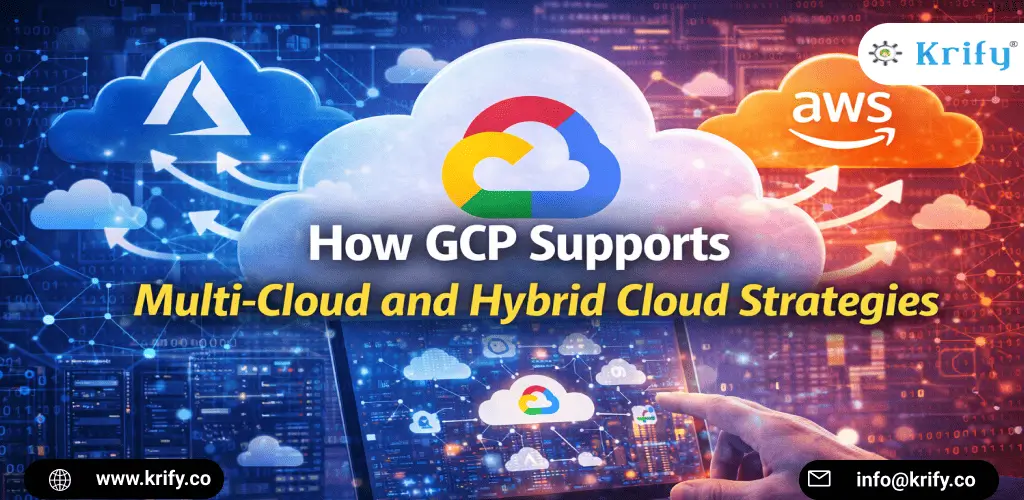
If you talk to technology leaders today, one thing becomes clear very quickly—most companies no longer want to depend on a single cloud provider. They want flexibility. They want backup options. And, honestly, they want the freedom to choose what works best at any given moment. That’s why conversations around how GCP supports multi-cloud and hybrid cloud strategies are becoming more common. At Krify, we’ve worked with teams that started with one cloud and slowly realized that a mixed approach simply made more sense for their business.
Cloud decisions aren’t just technical anymore. They’re strategic. And once systems grow, switching or expanding becomes much harder unless the foundation is designed with flexibility in mind.
Why Businesses Are Moving Away From Single-Cloud Setups
Relying on one cloud provider can feel comfortable at first. Everything lives in one place. Billing is simple. Tools are familiar. However, over time, limitations start to show.
Some teams worry about vendor lock-in. Others need better disaster recovery options. Meanwhile, many companies discover that different providers excel at different things. Therefore, using more than one cloud—or mixing cloud with on-premise systems—often becomes a practical decision rather than a theoretical one.
This shift is exactly where GCP fits in naturally.
How GCP Supports Multi-Cloud and Hybrid Cloud Strategies
Built Around Open Technologies GCP Cloud Strategies
One reason GCP adapts well to multi-cloud setups is its strong connection to open-source tools.
Google created Kubernetes, which now runs workloads across nearly every major cloud platform. Because of this, applications built on Kubernetes behave consistently whether they run on GCP, another public cloud, or even inside a company’s own data center.
Anthos Brings Everything Together GCP Cloud Strategies
Managing multiple environments can quickly become overwhelming. Different dashboards, different security models, different deployment rules—it adds up.
Anthos helps simplify that complexity. It allows teams to manage workloads across clouds and on-premise systems from a single place. Instead of juggling tools, teams gain visibility and control in one layer.
This unified view often reduces operational stress more than people expect.
Security That Doesn’t Change With Location
Security becomes tricky when applications span multiple environments.
GCP addresses this by allowing consistent identity management, access control, and policy enforcement across clouds. In practice, that means teams don’t have to rethink security every time a workload moves.
For regulated industries especially, this consistency matters a lot.
Hybrid Networking Without Major Disruption GCP Cloud Strategies
Many businesses can’t move everything to the cloud overnight. Legacy systems still exist, and some data needs to stay on-premise.
GCP supports secure hybrid networking that connects cloud services with existing infrastructure. These connections are designed to be stable and low-latency, which helps avoid performance surprises.
Therefore, businesses can modernize gradually instead of all at once.
Data Can Live Where It Makes Sense
In real life, data rarely sits in one location.
Some data stays on-premise for compliance reasons. Other data lives in the cloud for analytics and scalability. GCP supports this reality by allowing data integration across environments without forcing everything into one place.
Consequently, teams keep control without sacrificing insight.
Modernization Without Breaking Legacy Systems
A common fear around cloud migration is disruption.
GCP’s hybrid approach allows companies to modernize piece by piece. Older systems can continue running while new services move to the cloud. Over time, teams transition at a pace that feels safe rather than rushed.
This slow-and-steady approach often leads to better long-term results.
Practical Benefits Teams Notice Over Time
Organizations using GCP in hybrid or multi-cloud setups often experience:
- More flexibility in vendor choices
- Better disaster recovery planning
- Easier workload movement
- Clearer visibility across environments
- Fewer long-term architecture regrets
How Krify Helps Teams Use GCP Effectively
Designing a hybrid or multi-cloud setup isn’t just about tools. It’s about planning.
At Krify, we work closely with teams to understand their current systems, future goals, and operational limits. From there, we help design GCP-based architectures that feel manageable, secure, and scalable over time.
The focus is always on clarity, not complexity.
Conclusion
Cloud strategy today is about flexibility, not commitment to a single path. How GCP supports multi-cloud and hybrid cloud strategies shows why many businesses choose it as a stabilizing layer across diverse environments. When implemented thoughtfully, GCP helps teams stay adaptable without losing control. If you’re considering a hybrid or multi-cloud direction and want guidance that’s practical, not theoretical, Contact us—Krify is happy to help you map the right approach.