






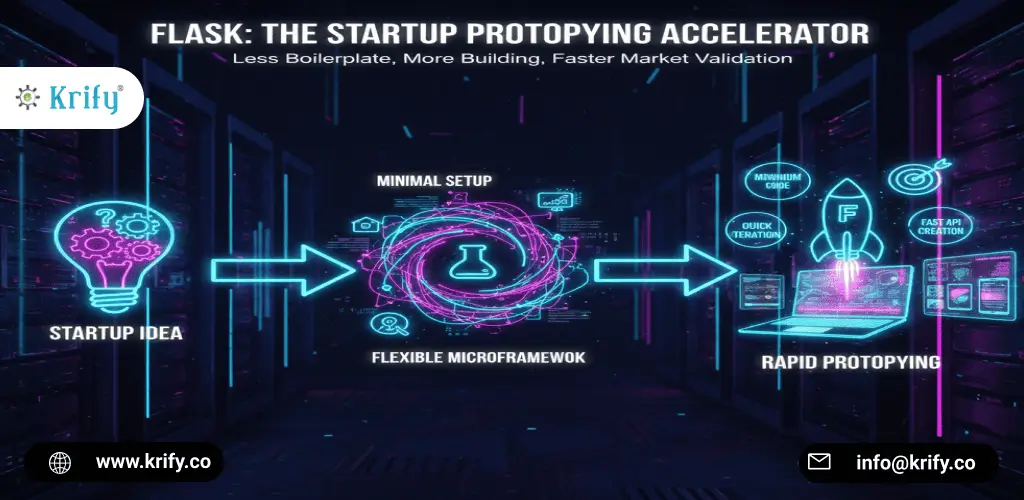
If you’ve spent any time around startups, you already know how quickly things move. Ideas evolve, features change, and timelines shrink almost overnight. That’s exactly why Flask Prototyping has become such a popular approach for early-stage teams. Startups don’t need heavy frameworks or long setup cycles at the beginning. Instead, they need something flexible, lightweight, and fast. At Krify, we’ve seen many teams choose Flask because it lets them focus on building ideas rather than wrestling with structure. Moreover, Flask gives startups room to experiment without locking them into rigid decisions too early.
Prototyping isn’t about perfection. However, it is about speed, clarity, and learning. Therefore, the simpler the tool, the easier it becomes to test assumptions and adjust direction.
Flask Prototyping and the Startup Mindset
Flask fits naturally with how startups think and work. It doesn’t force opinions or complex patterns upfront. Instead, it gives developers a clean base and lets them decide what to add next.
For example, when a startup wants to test a new feature idea, Flask allows them to build a working version quickly. In addition, unnecessary components can be skipped until they’re truly needed. As a result, teams stay agile rather than overwhelmed.
Moreover, Flask keeps code readable. That matters when teams are small and roles overlap. Consequently, onboarding new developers becomes easier.
Why Flask Works So Well for Early MVPs
Most startups begin with an MVP, not a finished product. Flask supports this approach perfectly.
First, setup is quick. Developers can spin up a working app in minutes. Therefore, feedback cycles shorten. Second, Flask doesn’t hide what’s happening behind the scenes. As a result, teams understand their system better from day one.
In addition, Flask integrates easily with tools startups already use. Whether it’s a simple database, a payment API, or a third-party service, connections remain straightforward.
Flexibility Without Unnecessary Complexity
Some frameworks come with everything pre-built. That can be helpful later, but early on it often slows teams down. Flask avoids that problem.
Instead, developers add only what the project needs. For instance, authentication, admin panels, or background jobs can be introduced gradually. Meanwhile, the core app stays lean.
This flexibility helps startups avoid over-engineering. Moreover, it keeps technical debt under control during early growth.
Faster Iteration Means Better Decisions
Speed matters when resources are limited. Flask allows startups to iterate quickly, test ideas, and adjust based on real feedback.
For example, if a feature doesn’t perform well, it can be changed or removed without major refactoring. Consequently, teams learn faster and waste less time.
At Krify, we’ve noticed that projects built with Flask during the prototyping phase tend to make cleaner transitions into more structured systems later.
Easy Transition from Prototype to Production
One concern startups often have is whether a prototype can evolve into a real product. With Flask, that transition is realistic.
As the product matures, teams can add structure, improve performance, and scale gradually. In addition, Flask works well with cloud platforms and microservices. Therefore, growth doesn’t require starting over.
Why Startups Choose Flask Over Heavier Frameworks
Startups value clarity, speed, and control. Flask delivers all three.
While heavier frameworks shine in large systems, Flask shines at the beginning. It keeps teams focused on validating ideas, not maintaining complexity. Moreover, it supports long-term growth when handled thoughtfully.
That balance makes Flask a practical choice rather than a temporary shortcut.
Conclusion
Prototyping is about learning fast and building smart. Flask Prototyping helps startups turn ideas into working products without unnecessary friction. It keeps development lightweight, flexible, and focused on real outcomes. If you’re planning to build an MVP or explore a new product idea, Contact us to see how Flask can support your startup’s journey from concept to launch.